Steam
One of the pre-installed applications in the default Wolf configuration is Steam. Getting Steam to work in a headless container took some work, so this page lists some limitations and tips to get the most out of Steam.
Directly launch a Steam game
In order to directly launch a Steam game from Moonlight you can just copy the existing entry for Steam, change the name and just add the Steam app ID as env variable; example:
[[apps]]
title = "Elden Ring"
start_virtual_compositor = true

[apps.runner]
env = [
  "PROTON_LOG=1",
  "RUN_SWAY=true",
  "GOW_REQUIRED_DEVICES=/dev/input/* /dev/dri/* /dev/nvidia*",
  "STEAM_STARTUP_FLAGS=steam://rungameid/1245620"
]
# COPY EVERYTHING ELSE ...
You can get the app ID from https://steamdb.info/
(Thanks to @nathanle1406 for the tip)
MangoHud
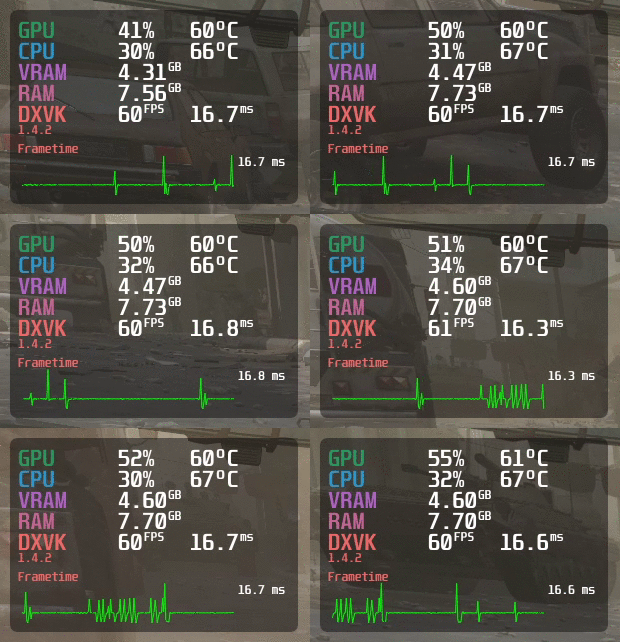
The steam overlay currently does not work in our headless container. So if you want to see FPS and other stats you can use FlightlessMango’s excellent MangoHud.
Proton (Steam Play) and other Vulkan games
It’s already installed and enabled in the default steam image for all Vulkan games (including Proton games).
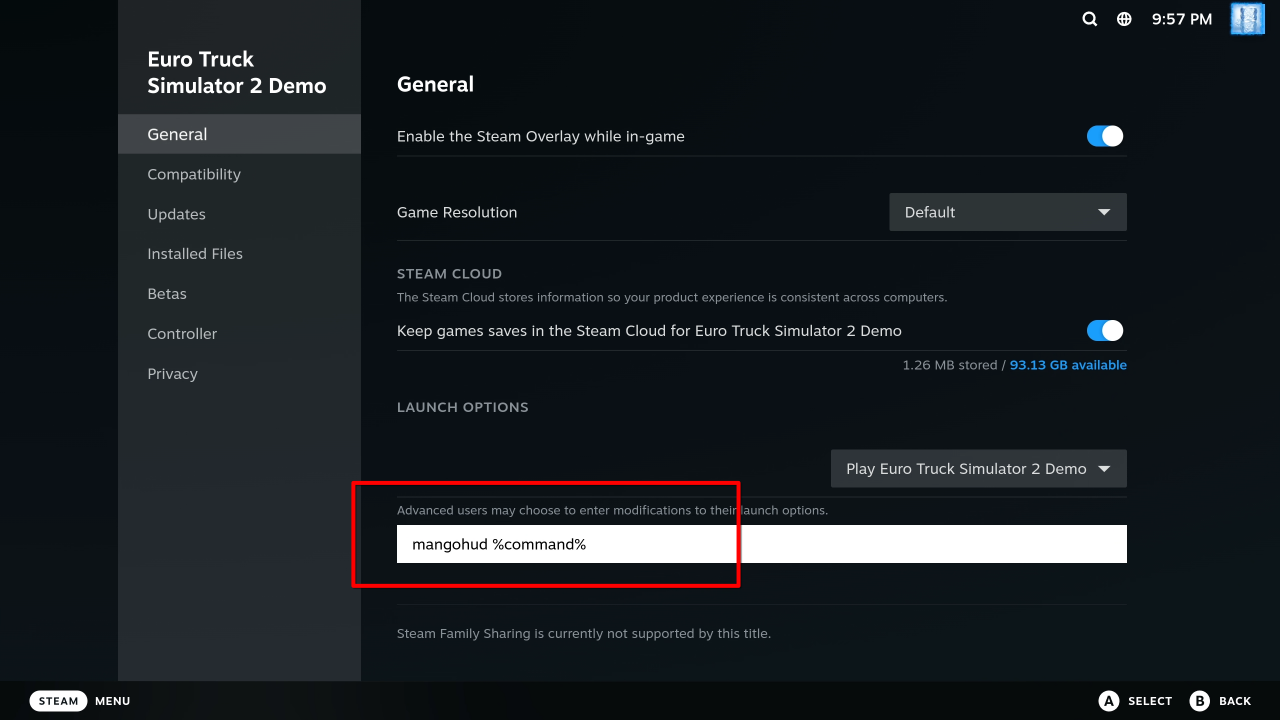
See below for how to activate it in game.
Using alternative Proton
From where your /etc/wolf is mounted in your host, add the desired proton files to /etc/wolf/profile_data/${profile_id}/WolfSteam/.steam/debian-installation/compatibilitytools.d/
|
In order to add this, you must have already started the user once for said profile_id. Additionally, you may have to create the |
Example for ProtonGE
-
Download the latest ProtonGE release from https://github.com/GloriousEggroll/proton-ge-custom/releases
-
Extract the release tarball into
/etc/wolf/profile_data/${profile_id}/WolfSteam/.steam/debian-installation/compatibilitytools.d/ -
Restart Steam
-
Select the desired ProtonGE version in the Steam game’s properties under "Compatibility"'
Setting up a shared library
Setting the mount point
The host’s library will need to mounted to the container.
This is easily accomplished by using the mounts option in the config.toml file.
Set mounts = [ '/path/to/steamapps:/home/retro/.steam/debian-installation/steamapps:rw' ] in the Steam block and restart Wolf.
Permissions
The library needs to be owned by user:group 1000:1000 for the container to access it. The library needs all permissions given to it for proper function.
When a new user is added, permissions prevent proper initialization of the first run of the container.
It will fail to load due to /home/retro/.steam/ubuntu12_32/ and /home/retro/.steam/ubuntu12_32/steam-runtime not having the proper permissions.
Once the first run has been attempted, these can be chown 'd to 1000:1000 and chmod 'd to 777.
This script performs a quick and easy fix for this. Usage is simple: run the Steam app once as the new user, letting it crash, and then run this script with bash mk_steam_dir.sh userid to correct the issue. Second start of the app with the new user should start with the Updating Steam dialogue. If you changed the default location where Wolf stores its persistent data, you’ll need to update the BASE variable in the script.
mk_steam_dir.sh
#!/bin/bash
# Assign the base path for your Wolf persistent data:
BASE=/etc/wolf
# Check if the first argument is empty
if [ -z "$1" ]; then
    echo "Error: You must provide the user's data directory. This is their 'id' entry in the config file."
    echo "Usage: $0 <user-directory>"
    exit 1
fi
# Check if the user's WolfSteam directory exists
if [[ ! -d "$BASE/profile-data/$1/WolfSteam" ]]; then
    echo "Please run Steam once (it will crash) from the user '$1' and then run this script."
    exit 1
fi
# Create required subdirectories
mkdir -vp "$BASE/profile-data/$1/WolfSteam/.steam/ubuntu12_32/steam-runtime"
# Set ownership and permissions
chown -Rv 1000:1000 "$BASE/profile-data/$1/WolfSteam"
chmod -Rv 777 "$BASE/profile-data/$1/WolfSteam"